|
Avneet Kaur
avneetreen[dot]github[dot]io
Hi, I'm Avneet. Based in Copenhagen, I'm an AI Engineer building agentic AI systems and data foundations on the cloud for enterprise platforms across pharma, supply chain and energy. I hold a Master's degree in Computer Science from the University of Copenhagen, specializing in Machine Learning and Data Sciences. My research and professional interests are in Agentic AI, AI Safety, developing robust frameworks for secure AI deployment, exploring LLM architectures and responsible deployment, and building intelligent language systems with emphasis on safety and alignment.
Email • Linkedin • Google Scholar • Github |

|
Selected Research & Projects

|
AI-Based Field Boundary Delineation from Satellite Imagery University of Copenhagen, Department of Computer Science, DHI Avneet Kaur, in collaboration with Stefan Oehmcke, Kenneth Grogan Automated mapping of agricultural field boundaries in Denmark from Sentinel-2 satellite imagery, in collaboration with DHI. I built the full pipeline, from monthly median composites and label generation to a ResUNet that jointly predicts field extent, boundaries and distance to the nearest boundary, with post-processing into individual parcels. Preliminary results reached about 80% accuracy on held-out regions. Code / PDF / Slides |
|
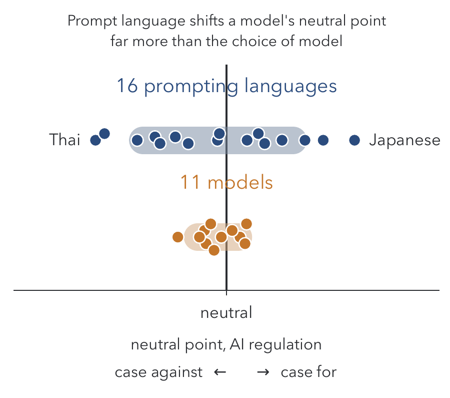
Clash of Languages: A Model's Neutral Point Moves with the Prompting Language EACL 2027, European Chapter of the Association for Computational Linguistics Alfonso Amayuelas, Efstathios Siatras, Nikolas Belle, Dakota Barnes, Antonina Sinelnik, Ashay Srivastava, Drishti Sharma, Avneet Kaur, William Yang Wang We evaluate 11 LLMs from 5 countries in 16 languages on 14 socio-political topics (~74,000 passages), locating each model's political "neutral point" with linear probes. The prompting language explains about 5× more variance than the choice of model, and the pattern transfers across models (mean r = 0.61), revealing language-driven biases that switching models does not remove. OpenReview / PDF |

|
An Automated, Reproducible Preprocessing Pipeline for PET Brain Imaging M.Sc. Thesis, University of Copenhagen, Department of Computer Science Avneet Kaur, supervised by Melanie Ganz-Benjaminsen, Martin Nørgaard, Vincent Beliveau An open, automated pipeline for preprocessing PET brain scans, built with Nipype on FreeSurfer, PETSurfer and FSL. It covers motion correction, co-registration, volume-of-interest delineation, partial volume correction and kinetic modelling, and was validated for reproducibility on three datasets from different scanners and tracers. Part of the open-source OpenNeuroPET project. Code / PDF / Slides |
|
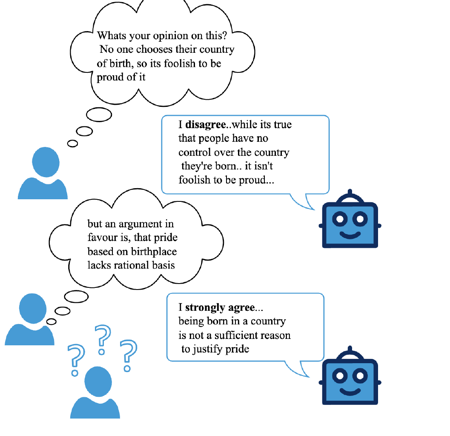
Echoes of Agreement: Argument Driven Sycophancy in Large Language Models Findings of EMNLP 2025 Avneet Kaur This paper studies how arguments inside a prompt make LLMs sycophantic on political topics. Models consistently shift their answers to mirror the user's stance, in both single-turn and multi-turn conversations, and the effect grows with argument strength. This reveals a vulnerability for reliable real-world deployment and calls for robust evaluations and mitigations. Code / ACL Anthology / PDF |

|
AI-Driven Synthetic Chart Data Generation for Vision Language Models Expedition Aya 2025, Cohere Labs Avneet Kaur, Dante Lok, Reuben Chagas Fernandes Vision Language Models struggle with charts because training data rarely contains them. Our pipeline has an LLM write plotting code from tabular data to render diverse charts, generates question-answer pairs (numerical reasoning, summarization, anomaly detection, forecasting), and evaluates VLMs with ground-truth checks, VLM-as-a-judge and human review. Code / Slides |
|
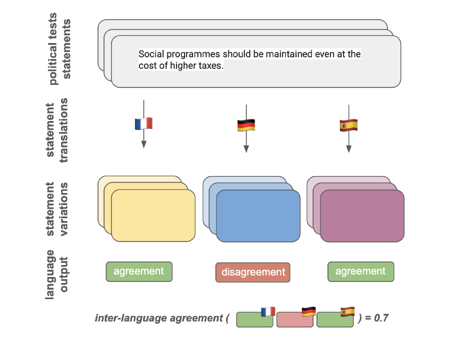
Language-Based Opinion Shifts: Exploring the Language Effect in Multilingual Language Models Regarding Political Opinions Expedition Aya 2024, Cohere Labs A multilingual framework to measure how the prompt language changes the political opinions LLMs express. We benchmarked six multilingual LLMs across 23 languages (about half of the world's population), introduced a metric for language-specific sensitivity to political bias, and studied the effects on downstream tasks such as harmful text generation. PDF / Slides / Featured as the most innovative project by Cohere for AI |

|
Safe and Multilingual RAG Chatbot for Climate Education Expedition Aya, Cohere Labs A multilingual RAG chatbot, built with Climate Resilient Communities, that makes local climate information accessible to Torontonians regardless of their language. Answers are grounded in curated climate documents, translated with Cohere's Aya models, and wrapped in safety layers: input guardrails, PII redaction, retrieval relevance checks and output fact-checking. Code / Slides / Winning project, Cohere for AI blog |
|
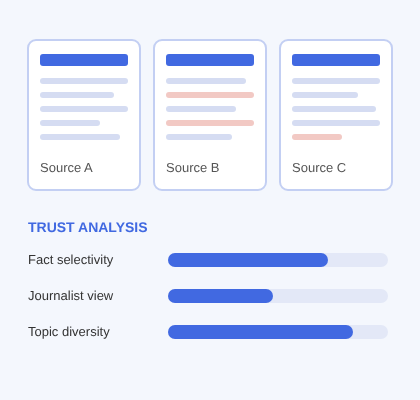
Multidimensional Analysis of Trust in News Articles AAAI 2020 (Student Abstract) Avneet Kaur, Maitree Leekha, Utkarsh Chawla, Ayush Agarwal, Mudit Saxena, Nishtha Madaan, Kalapriya Kannan, Sameep Mehta A system that helps readers decide which news coverage to trust, developed with IBM Research AI. Inspired by Kohring and Matthes' model of trust in journalism, it analyses articles at three levels: the selectivity of facts across outlets covering the same event, how journalists portray news entities, and the diversity of topics a media house covers over time. Paper |
|
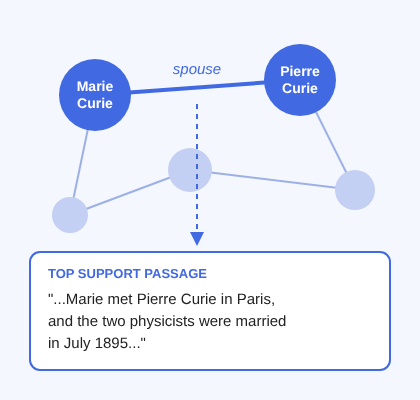
That's Interesting, Tell Me More! Finding Descriptive Support Passages for Knowledge Graph Relationships ISWC 2018, International Semantic Web Conference Sumit Bhatia, Purusharth Dwivedi, Avneet Kaur Knowledge graphs store facts but not the context that explains them. Given a relationship between two entities, our probabilistic, language-model-based method ranks the text passages that best describe it, combining passage-level and document-level evidence. We evaluated it with Wikidata and Wikipedia through user studies. Paper / arXiv / Talk |
|
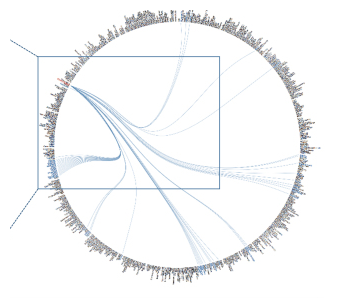
FlavorDB: A Database of Flavor Molecules Nucleic Acids Research, 2018 Neelansh Garg, Apuroop Sethupathy, Rudraksh Tuwani, Rakhi NK, Shubham Dokania, Arvind Iyer, Ayushi Gupta, Shubhra Agrawal, Navjot Singh, Shubham Shukla, Kriti Kathuria, Rahul Badhwar, Rakesh Kanji, Anupam Jain, Avneet Kaur, Rashmi Nagpal, Ganesh Bagler A public database of 25,595 flavor molecules covering a wide range of tastes and odors, 2,254 of them linked to 936 natural ingredients across 34 categories. It supports search by molecular properties, flavor profiles and ingredients, with interactive visualizations for exploring flavor pairing. Paper / Website |